






If you’ve ever felt like cricket betting is just a PvE grind against the house, you’re not wrong. But what if you could switch to PvP and be the house? Welcome to the world of betting exchanges, the ultimate competitive lobby where the traditional rules get a massive buff. Here, you’re not just placing bets; you’re entering a dynamic, player-driven marketplace. Let’s break down the two fundamental moves: the back bet and the lay bet.
Welcome to the Betting Arena: The Lowdown on Back and Lay Bets
Think of traditional sports betting as a single-player campaign. A betting exchange, on the other hand, is a full-blown battle royale where you can challenge other punters directly. Understanding back and lay bets is your entry key to this high-skill, player-driven environment.
Backing Your Champion: The Core Mechanic
A back bet is the bread and butter of betting—it’s the classic move everyone knows, the basic attack in your combo. You’re putting your money on something to happen. Simple as that.
A back bet is a wager that an outcome will occur. For example, backing India to win a T20 match means you win your bet only if India achieves the victory condition.
This is the most straightforward way to bet and is the foundation of all sports wagering, whether you’re at a traditional bookmaker or on an exchange.






Becoming the Bookie: The Advanced Skill
Now for the OP strat. A lay bet flips the script entirely. You’re betting on something not to happen. By placing a lay bet, you are effectively taking on the role of the raid boss, accepting another player’s back bet.
Imagine you’re confident that the pre-match favourite is going to get nerfed and lose. You can ‘lay’ them, meaning you win if they lose or if the match ends in a draw. It’s a powerful tool, but it comes with a different kind of risk since your potential liability (the damage you take if you lose) is higher than your stake.
To put it simply, here’s a quick comparison.
Back Bet vs Lay Bet: Quick-Look Stats
| Feature | Back Bet (You’re the Player) | Lay Bet (You’re the House/Boss) |
| Your Goal | Predict an outcome that will happen. | Predict an outcome that will not happen. |
| Example | You bet on Virat Kohli to score a century (hit a crit). | You bet that Virat Kohli will not score a century (he’ll miss). |
| How You Win | Your prediction comes true. | Your prediction comes true (the original event doesn’t happen). |
| Risk | You risk losing your original stake (your HP). | You risk paying out the backer’s winnings (your liability/aggro). |
This table shows the core difference at a glance. Backing is about being right once; laying is about someone else being wrong.
Mastering these two concepts is the first step toward developing more sophisticated, S-tier betting strategies. For those just starting out, getting the basics right is crucial.
Mastering the Back Bet: Your Go-To Offensive Play
The back bet is the bread and butter of cricket betting. If you’ve ever put money on a team to win a match, you’ve already placed a back bet without even knowing its official name. It’s the most straightforward way to get in on the action.
Think of it like this: when you back a team, you’re putting your money on a specific outcome happening. You’re simply saying, “I think this team will win,” and placing a wager to prove it.
How it Works in Practice
Let’s dive into a real-world scenario. Imagine a high-voltage T20 match between India and Pakistan is about to start, and you’re browsing a betting exchange. You see the odds for an India victory and decide you want to back them.
This is the most common move in the Indian cricket betting scene. Let’s say you back India to win at odds of 2.10. If you stake ₹1,000 and your bet is accepted, a win for India would pay out ₹2,100—that’s your original ₹1,000 stake back, plus a cool ₹1,100 in profit.
The Deal with Unmatched Bets
Now, here’s where betting exchanges differ from your traditional bookmaker. Exchanges are peer-to-peer platforms, which means for your bet to be official, someone on the other side needs to accept your challenge. Your ‘back’ bet needs to be accepted, or ‘matched’, by someone willing to ‘lay’ it.
But what if your bet doesn’t get matched right away? This happens sometimes, and it’s usually for a couple of key reasons:
- No Takers: There simply isn’t enough liquidity from other players willing to bet against you at the odds you’ve chosen. The queue is empty.
- Shifting Odds: Cricket is a fast-paced game. A wicket falls or a boundary is hit, and the odds can change in a flash, sometimes before your full stake gets matched. The game’s meta shifted too quickly.
Getting the hang of the back bet is your first major milestone. It’s how you start to build your bankroll and get a feel for how the market moves. Once you’ve got this down, you’ll be ready to level up to more advanced strategies like lay betting.
The Lay Bet: Playing the Game as the Bookie
Ready to flip the script and think like a bookmaker? That’s exactly what a lay bet lets you do. Instead of betting on a team to win (which is called backing), you’re betting on them not to win. It’s a powerful counter-play that completely changes how you approach the game.
When you place a lay bet, you’re essentially taking the other side of someone else’s back bet. Think of it this way: you’re betting that the favourite will stumble or the underdog just won’t pull off the upset. You win your bet if the team you lay either loses the match or it ends in a draw—basically, any outcome except a win for them.
Understanding Your Liability
This is where lay betting has a completely different risk profile. With a standard back bet, the most you can ever lose is your stake. But when you lay an outcome, you need to have enough money in your account to pay the backer if their bet wins. This potential payout is known as your liability.
Your liability is the amount you stand to lose if your lay bet doesn’t come in. It’s calculated for you based on the odds and the other person’s stake, so you always know your maximum risk before you confirm anything. It’s the damage you’ll take if your opponent’s move connects.
For example, say you lay a team for ₹500 at odds of 3.0. Your potential profit is the backer’s ₹500 stake. But if that team does win, your liability is ₹1,000 (calculated as ₹500 x (3.0 – 1)). You’re the one on the hook for paying out their winnings.
Laying an Overhyped Favourite
Let’s walk through a clear example. Imagine Mumbai Indians are heavy favourites in an IPL match, trading at low odds of 1.50. You’ve done your homework and think they’re being overhyped and could easily get wiped. This is a perfect spot to lay them.
Here’s how it would play out:
- Your Bet: You lay Mumbai Indians for ₹1,000 at odds of 1.50.
- If Mumbai Indians Lose or Draw: Cha-ching! You win and collect the backer’s ₹1,000 stake (minus a small commission to the exchange). GG.
- If Mumbai Indians Win: This is the outcome you bet against. You lose the bet and have to pay out your liability of ₹500 (calculated as ₹1,000 x (1.50 – 1)). You got rekt.
Getting comfortable with lay betting is the key to unlocking more advanced trading strategies. It’s all about learning to predict what won’t happen, a crucial skill for finding value that other players might miss.
Live Match Gameplay: How to Use Back and Lay Bets in the IPL
Theory is one thing, but let’s see how these strats actually play out during a live match. We’ll use a classic high-stakes IPL clash—Mumbai Indians (MI) vs. Chennai Super Kings (CSK)—to show you exactly how back and lay betting works in the heat of the moment.
Think of this as your live match commentary for tactical betting.
The game kicks off with MI winning the toss and electing to bat first. The pre-match odds have them as slight favourites at 1.90. You’re confident their explosive opening pair will fire, so you decide to back MI for ₹1,000.
Reading the Mid-Game Meta
Just as you predicted, MI gets off to a blistering start. They smash boundaries left and right, racing to 60/0 after the first six overs. Unsurprisingly, their odds to win have now shortened dramatically, dropping all the way to 1.40. They’ve received a massive buff.
At this point, you could simply let your back bet ride and hope for the best. But a smart trader sees a golden opportunity to lock in a profit, no matter what happens next. This is where the lay bet becomes your ultimate ability.
You decide to lay MI at the new, lower odds of 1.40. This clever move, often called “greening up,” creates a scenario where you’re guaranteed to win. If MI goes on to win the match, your initial back bet pays out. If CSK mounts a comeback and wins, your new lay bet pays out instead. You’ve just traded your position for a small, guaranteed profit, completely removing any risk for the rest of the game.
This is the simple flow of a successful trade.
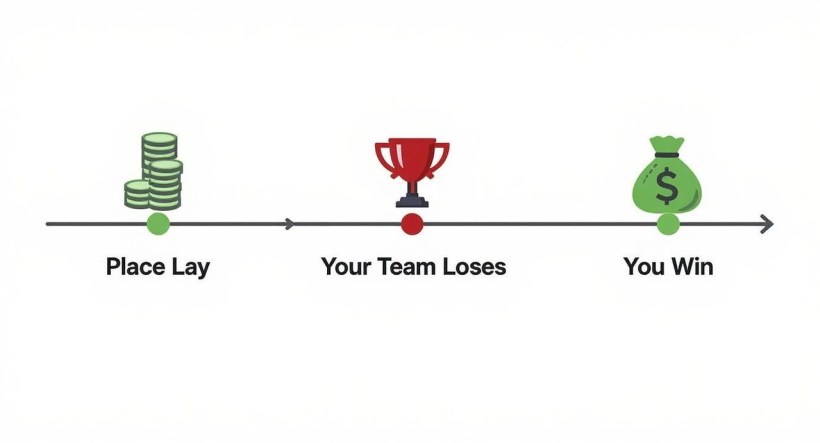
As you can see, you cash in on your lay bet when the team you bet against doesn’t end up winning.
Adapting to Momentum Shifts
Now, let’s imagine the game takes a sharp turn. MI’s star batsman gets out, followed by two more quick wickets. Suddenly, the momentum has swung, CSK is right back in it, and MI’s odds drift back out to a tempting 2.50. They’ve been debuffed.
This is another chance to use your tactical awareness. Seeing value, you could place a new back bet on MI at these much better odds, believing they have the depth to recover in the death overs.
By constantly reading the game’s flow—the powerplay, a key wicket, the final overs—you can use back and lay bets to react to momentum shifts. It’s not just about predicting the final winner; it’s about actively trading the odds as they change.
This dynamic approach transforms betting from a single pre-match guess into a living, in-game strategy. Just like in a real match, adapting your tactics is the key to coming out on top. For more tips on finding the right platform for this kind of betting.
Understanding the Player Meta: Common Betting Patterns
To really get an edge in cricket betting, you have to understand the people you’re betting against. Think of it like a video game—you need to know the “meta.” Just like knowing which character is overpowered in the latest update, understanding common betting patterns lets you spot opportunities that the average punter completely misses.
Let’s be clear: the average cricket bettor isn’t some high-roller executing complex trading strategies. Most are casual fans, placing small, straightforward bets driven by popular opinion and gut feelings. This herd mentality is what skews the odds, creating imbalances that a smarter player can exploit.
Reading the Crowd’s Playbook
A 2021 analysis of betting activity on a major Indian platform gave us a fascinating look into just how predictable the crowd can be. The data showed that over 90% of all bets were for amounts under ₹5,000. Even more telling, a massive 64% of all bets were under ₹1,000.
This tells a clear story: the market is flooded with low-stake, casual players who almost always stick to simple back bets. They are the noobs, not getting into the more advanced world of laying and trading.
Think of it this way: most players are just mashing the basic attack button. They follow the hype, backing the big-name teams and star players without ever digging deeper. This is your cue to come up with a counter-move.
This insight is pure gold. When public sentiment is overwhelmingly behind one team, the odds for backing them offer terrible value. But more importantly, the odds for laying them can become incredibly attractive.
Here’s a quick snapshot of the typical bettor, based on that data:
- Bet Size: Almost always small stakes, usually under ₹1,000.
- Bet Type: Overwhelmingly simple back bets placed on the favourites.
- Bet Timing: The vast majority (79%) of bets are placed live during the match, often as an emotional reaction to what’s happening on the field.
Knowing that the crowd is likely to panic and overreact to a single wicket or a big boundary allows you to take the opposite position. While everyone else is blindly following the meta, you can be the one to break it and find your own winning angle.
Frequently Asked Questions About Back and Lay Betting
Still have a few questions rattling around before you jump into the lobby? No worries. We’ve put together answers to the most common queries that trip up new players, giving you the confidence you need to get in the game.
What Is the Biggest Risk with Lay Betting?
The single biggest risk in lay betting comes down to one word: liability. This is the total amount of damage you stand to take.
When you place a simple back bet, the most you can lose is your stake. But when you lay a team, you’re effectively acting as the boss. That means you’re on the hook to pay out the backer’s winnings if they’re right, and that amount can be much, much higher than the small profit you stand to make. It’s absolutely vital to understand your liability before confirming any lay bet, especially on a longshot with high odds.
Can I Back and Lay the Same Team in One Match?
You absolutely can! In fact, this is the very heart of sports trading. Think of it like buying a rare skin for a low price and then flipping it on the marketplace for a profit when its value spikes.
For instance, you might back a team at high odds before the match begins. If they get off to a flying start and their odds plummet, you can then lay them at the new, lower price. This strategy, often called “greening up,” guarantees you a profit no matter who wins the match. You’ve cleverly locked in your winnings before the final ball is even bowled.
Is It Better to Back or Lay in Live Cricket Matches?
This is a great question, and the true answer is: it depends. Both are incredibly powerful tactics for in-play betting, which is where exchanges truly come alive as the odds shift with every boundary and wicket. Neither is “better”—it’s all about reading the flow of the match and making the right call at the right time.
- Backing is your go-to move when you sense a shift in momentum. Maybe a new batting partnership finds its rhythm and the run rate starts to climb.
- Laying is a smart play when you feel the market is overreacting. A single lucky six might cause odds to tumble, but if you believe it was a fluke, laying the team can be a profitable move when the odds correct themselves.
In-play trading is where real skill comes into play. It rewards players who can analyse the live action and anticipate how the market will react, turning deep game knowledge directly into profit. It becomes less about picking the final winner and more about trading the small windows of opportunity within the match itself.
What Does It Mean If My Bet Is Unmatched?
Seeing your bet as “unmatched” simply means that nobody on the other side of the exchange has accepted your offer at the price you’ve set. It’s like putting an item up for sale in an auction house—it just sits there waiting until a buyer agrees to your asking price.
Your bet can be partially matched (someone took a piece of your offer), fully matched, or stay completely unmatched. As the legal situation around online wagering continues to develop, understanding all aspects of how platforms operate is key; you can read more about the evolving legal framework of online gambling to stay informed.


